12/19/2011
Posts by : Admin
Poultry farming
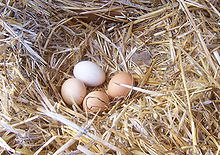
More than 50 billion chickens are reared annually as a source of food, for both their meat and their eggs.
The vast majority of poultry are raised using intensive farming techniques. According to the Wordwatch Institute, 74 percent of the world's poultry meat, and 68 percent of eggs are produced this way. One alternative to intensive poultry farming is free range farming.
Friction between these two main methods has led to long term issues of ethical consumerism. Opponents of intensive farming argue that it harms the environment, creates human health risks and is inhumane. Advocates of intensive farming say that their highly efficient systems save land and food resources due to increased productivity, stating that the animals are looked after in state-of-the-art environmentally controlled facilities.
In part due to the conditions on intensive poultry farms and recent recalls of large quantities of eggs, there is a growing movement for small scale micro-flocks or 'backyard chickens'. This involves keeping small numbers of hens (usually no more than a dozen), in suburban or urban residential areas to control bugs, utilize chicken waste as fertilizer in small gardens, and of course for the high-quality eggs and meat that are produced.
Posts by : Admin
Current
Under natural conditions, most birds lay only until a clutch is complete, and they will then incubate all the eggs. Many domestic hens will also do this–and are then said to "go broody". The broody hen will stop laying and instead will focus on the incubation of the eggs (a full clutch is usually about 12 eggs). She will "sit" or "set" on the nest, protesting or pecking in defense if disturbed or removed, and she will rarely leave the nest to eat, drink, or dust-bathe. While brooding, the hen maintains the nest at a constant temperature and humidity, as well as turning the eggs regularly during the first part of the incubation. To stimulate broodiness, an owner may place many artificial eggs in the nest, or to stop it they may place the hen in an elevated cage with an open wire floor.
At the end of the incubation period (about 21 days),[15] the eggs, if fertile, will hatch. Development of the egg starts only when incubation begins, so they all hatch within a day or two of each other, despite perhaps being laid over a period of two weeks or so. Before hatching, the hen can hear the chicks peeping inside the eggs, and will gently cluck to stimulate them to break out of their shells. The chick begins by "pipping"; pecking a breathing hole with its egg tooth towards the blunt end of the egg, usually on the upper side. The chick will then rest for some hours, absorbing the remaining egg yolk and withdrawing the blood supply from the membrane beneath the shell (used earlier for breathing through the shell). It then enlarges the hole, gradually turning round as it goes, and eventually severing the blunt end of the shell completely to make a lid. It crawls out of the remaining shell, and its wet down dries out in the warmth of the nest.
The hen will usually stay on the nest for about two days after the first egg hatches, and during this time the newly hatched chicks live off the egg yolk they absorb just before hatching. Any eggs not fertilized by a rooster will not hatch, and the hen eventually loses interest in these and leaves the nest. After hatching, the hen fiercely guards the chicks, and will brood them when necessary to keep them warm, at first often returning to the nest at night. She leads them to food and water; she will call them to edible items, but seldom feeds them directly. She continues to care for them until they are several weeks old, when she will gradually lose interest and eventually start to lay again.
Modern egg-laying breeds rarely go broody, and those that do often stop part-way through the incubation. However, some "utility" (general purpose) breeds, such as the Cochin, Cornish and Silkie, do regularly go broody, and they make excellent mothers, not only for chicken eggs but also for those of other species—even those with much smaller or larger eggs and different incubation periods, such as quail, pheasants, turkeys or geese. Chicken eggs can also be hatched under a broody duck, with varied success.
Posts by : Admin
General biology and habitat
Chickens are omnivores. In the wild, they often scratch at the soil to search for seeds, insects and even larger animals such as lizards or young mice.
Chickens may live for five to ten years, depending on the breed. The world's oldest chicken, a hen, died of heart failure at the age of 16 according to the Guinness Book of World Records.
Roosters can usually be differentiated from hens by their striking plumage of long flowing tails and shiny, pointed feathers on their necks (hackles) and backs (saddle) which are typically of brighter, bolder colors than those of females of the same species. However, in some breeds, such as the Sebright, the rooster has only slightly pointed neck feathers, the same color as the hen's. The identification must be made by looking at the comb, or eventually from the development of spurs on the male's legs (in a few breeds and in certain hybrids the male and female chicks may be differentiated by color). Adult chickens have a fleshy crest on their heads called a comb or cockscomb, and hanging flaps of skin either side under their beaks called wattles. Both the adult male and female have wattles and combs, but in most breeds these are more prominent in males. A muff or beard is a mutation found in several chicken breeds which causes extra feathering under the chicken's face, giving the appearance of a beard.
Wild Red Junglefowl
Domestic chickens are not capable of long distance flight, although lighter birds are generally capable of flying for short distances, such as over fences or into trees (where they would naturally roost). Chickens may occasionally fly briefly to explore their surroundings, but generally do so only to flee perceived danger.
Chickens are gregarious birds and live together in flocks. They have a communal approach to the incubation of eggs and raising of young. Individual chickens in a flock will dominate others, establishing a "pecking order", with dominant individuals having priority for food access and nesting locations. Removing hens or roosters from a flock causes a temporary disruption to this social order until a new pecking order is established. Adding hens—especially younger birds—to an existing flock can lead to violence and injury. Hens will try to lay in nests that already contain eggs, and have been known to move eggs from neighboring nests into their own. Some farmers use fake eggs made from plastic or stone (or golf balls) to encourage hens to lay in a particular location. The result of this behavior is that a flock will use only a few preferred locations, rather than having a different nest for every bird.
Hens can also be extremely stubborn about always laying in the same location. It is not unknown for two (or more) hens to try to share the same nest at the same time. If the nest is small, or one of the hens is particularly determined, this may result in chickens trying to lay on top of each other.
Skull of a chicken three weeks old. Here the opisthotic bone appears in the occipital region, as in the adult Chelonian. bo = Basi-occipital, bt = Basi-temporal, eo = Opisthotic, f = Frontal, fm = Foramen magnum, fo = Fontanella, oc = Occipital condyle, op = Opisthotic, p = Parietal, pf = Post-frontal, sc = Sinus canal in supra-occipital, so = Supra-occpital, sq = Squamosal, 8 = Exit of vagus nerve.
Roosters crowing (a loud and sometimes shrill call) is a territorial signal to other roosters. However, crowing may also result from sudden disturbances within their surroundings. Hens cluck loudly after laying an egg, and also to call their chicks. Chickens also give a low "warning call" when they think they see a predator approaching.
In 2006, scientists researching the ancestry of birds "turned on" a chicken recessive gene, talpid2, and found that the embryo jaws initiated formation of teeth, like those found in ancient bird fossils. John Fallon, the overseer of the project, stated that chickens have "...retained the ability to make teeth, under certain conditions...
Posts by : Admin
Terminology
In the UK, Ireland and Australia adult male chickens over the age of 12 months are primarily known as cocks, whereas in America and Canada they are more commonly called roosters. Males under a year old are cockerels. Castrated roosters are called capons (surgical and chemical castration are now illegal in some parts of the world). Females over a year old are known as hens, and younger females are pullets. In Australia and New Zealand (also sometimes in Britain), there is a generic term chook to describe all ages and both sexes. Babies are called chicks, and the meat is called chicken.
"Chicken" originally referred to chicks, not the species itself. The species as a whole was then called domestic fowl, or just fowl. This use of "chicken" survives in the phrase "Hen and Chickens", sometimes used as a British public house or theatre name, and to name groups of one large and many small rocks or islands in the sea (see for example Hen and Chicken Islands).
In the Deep South of the United States chickens are also referred to by the slang term yardbird.
11/01/2011
Posts by : Admin
THE CHICKEN
THE CHICKEN
With a population of more than 24 billion in 2003, Firefly's Bird Encyclopaedia says there are more chickens in this world than any other bird. Chickens supply two sources of protein in food: chicken meat and eggs.[Edit] Biology and habitat
Domesticated fowl originating from the red jungle fowl (chicken bangkiwa, Gallus Gallus) who live in India. However, molecular testing suggests possible genetic contribution of G. sonneratii, because the red jungle fowl do not have yellow skin trait that became a feature of pet chickens.
Chickens showed morphological differences between the two types of sex (sexual dimorphism). Rooster (jago, rooster) is more attractive, larger in size, has a long spur, berjengger larger, and long tail feathers dangle. Hen (hen, hen) is relatively small, small, spur short or barely visible, small berjengger, and short tail feathers. Sex is regulated by the hormone system. In the event of disturbances in body physiology function, hens can change sex to male because adult chicken ovotestis still have a dormant and can be active at any time.
As pets, chickens are able to follow where humans carry. These animals are very adaptive and can be said to live in any place, provided that the available food for him. Because most pet chickens have lost the ability to fly well, they spend less time on the ground or sometimes in trees.
Small-sized chicken occasionally preyed upon by birds of prey, like hawks.Chicken eggs.Roosters were crowing in the morning.[Edit] Various kinds
Because the chicken including the popular and inexpensive domestic birds, appear due to various technical terms and poultry breeding activities.
By function
According to its function, is the knowledge
or broiler chicken (broiler), to be utilized flesh;
laying hens (layers), to use her eggs;
ornamental chicken or chicken pet (pet, Klangenan), to be released in the garden / park or maintained in confinement due to the appearance or beauty of his voice (eg dwarf chickens and chicken pelung; bekisar chicken can also be classified here even though not a true fowl);
chicken soap, to be a game of cockfighting.
The term used for chicken vegetable or chicken fighting cocks that always loses, and not specifically selected as the broiler.
Based on race
Chicken Sumatra
In Indonesia, the technical term chicken and chicken rather than race (native, or village). Within the meaning of "chicken race" according to the term in question is actually a race that was developed for mass commercial business, such as the Leghorn ("lehor"). Into groups of domestic poultry, there is also a local race of the typical chicken but not developed for mass commercial venture. The chickens of local races so now beginning to be developed (purified) as chicken soap, chicken pet (pet), or for rituals. Here is a local race of chickens in the archipelago that have been developed for the nature / specific performance:
pelung chicken, local races and the superior of Preanger (Cianjur) which has a typical kokokan (long and unique tone), including ornamental chickens;
kedu chicken (including chicken cemani), local and noble race of Kedu region with a characteristic color to jet black muzzle and the meat, including chicken broiler and ornamental;
Nunukan chicken, local and noble race of Nunukan, East Kalimantan, with a straight body shape and large size, the descendants of fighting cocks, including broilers and ornamental;
Based on outward appearance (phenotype) typical
Chicken "bantamweight" is the English term for dwarf or semi dwarf chicken selection results.
There are also several terms to describe the typical appearance of a particular phenotype, but nature is not always exclusive to certain races, such as
Walik chicken (frizzle), chicken with no feathers that cover the body but stood upright;
bali chicken, chicken with no feathers and crested neck in his head, now starting dibiakmurnikan.
dwarf chicken (bantamweight), a general term for chicken with a small size (the proportion of leg length with body size smaller than chicken "normal"), there are various local races and race pure selection in this category.
Source : about this articels
Langganan:
Postingan (Atom)


dani
andang